Election Scorecard 2026
Young people’s priorities. Where the parties stand.
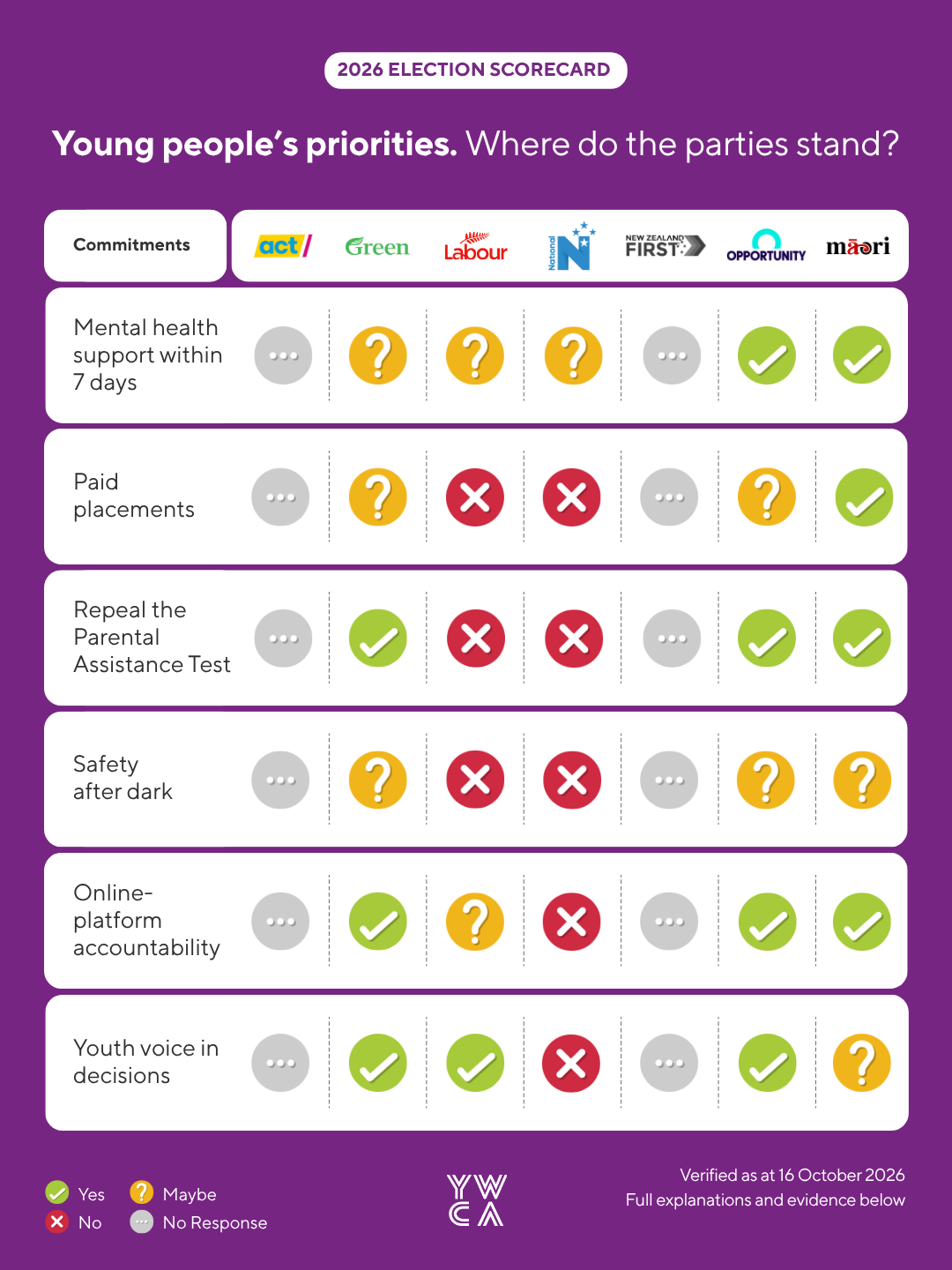
Developed by YWCA Auckland, the 2026 Election Commitments Scorecard responds to priorities shared by young women and gender-diverse people through our Your Voice Matters survey. We asked political parties to respond to six specific commitments. Explore their positions and the explanations behind each label.
Published 19 October 2026. Verified as at 16 October 2026.
How to read the Scorecard
Yes: commits to the full published requirement.
Maybe: partial or conditional support, or policy still being developed.
No: does not commit to the requirement.
No response: no authorised party answer; this does not automatically mean opposition. Where relevant, we also describe verified official party policies, but these are not treated as answers to our questionnaire.
The same requirements apply to every party. There are no points, overall scores, rankings or endorsements. We do not tell people how to vote.
Compare all seven parties across the six commitments, then read the explanations and evidence below.
The Six Commitments
Select a commitment to read the parties’ responses, explanations and evidence.
- Mental health support before crisis
- Paid compulsory placements
- Fair access to income support
- Safer public spaces after dark
- Platform accountability for online harm
- Young people having a real say
How we produced the Scorecard
Read our methodology, assessment requirements and factual-checking process.
Mental health support before crisis
Why this matters
In Your Voice Matters, 43% of respondents identified mental health as one of their biggest day-to-day pressures. Young people asked for free or affordable support before crisis, including counselling, peer and whānau support, and services that are culturally safe and inclusive.
What we asked
Will your party commit to ensuring that young people aged 15–30 can receive a free first session of appropriate primary or community-based mental-health support within seven days of seeking help, before they reach crisis?
What a Yes means
A Yes means committing to fund and implement a national seven-day access standard for people aged 15–30. Within seven calendar days of a service receiving their request or referral, the person must receive a substantive session providing therapeutic, peer, whānau or other appropriate support. The session may include assessment, but triage alone, an assessment that provides no immediate support, a referral onward or placement on a waiting list would not meet this threshold. Specialist treatment would not have to begin within seven days.
The survey did not specify a timeframe. The seven-day benchmark is the Y’s proposed measurable commitment in response to the call for timely help before crisis.
Party positions

ACT — No response
ACT did not submit an authorised questionnaire response. No response does not indicate opposition to this commitment.
Evidence: questionnaire receipt record following the 7 October 2026 survey closure; No response status confirmed 9 October 2026.
Green Party — Maybe
The Green Party proposes expanding free mental-health services, including Piki, Mana Ake and Youth One Stop Shops, alongside early intervention and kaupapa Māori support. Their manifesto does not specify the full national seven-day access standard for everyone aged 15–30. The Scorecard retains Maybe because its original survey answer was Maybe and its later written Yes has not been confirmed as replacing that answer.
Evidence: Authorised questionnaire response received 5 October 2026 and written response received 9 October 2026.
Labour — Maybe
Labour supports prevention and early intervention and says its full mental-health policy is still to come. Their reply does not commit to the full national seven-day access standard.
Evidence: Authorised Labour questionnaire response received 2 October 2026.
National — Maybe
National supports faster access to mental-health support and points to existing counselling, specialist services and performance reporting. They have not committed to the full national seven-day standard for everyone aged 15–30. Y summary of National’s response; not verbatim.
Evidence: Authorised questionnaire response received 2 October 2026; C1 clarification received 9 October 2026. Factual-check reply received 15 October 2026.
Supporting policy: Youth mental health target data reported for first time.
NZ First — No response
New Zealand First did not submit an authorised questionnaire response. Its Make NZ Healthy policy focuses on preventing illness and includes funding research into nutritional approaches to preventing and treating mental illness. This does not establish whether the party would support a free first session of appropriate mental-health support within seven days for everyone aged 15–30. No response does not indicate opposition to this commitment.
Evidence: questionnaire receipt record following the 7 October 2026 survey closure; No response status confirmed 9 October 2026.
supporting policy: The Plan to Make NZ Healthy
Opportunity — Yes
Opportunity answers Yes to the full national seven-day mental-health access commitment. Their explanation places mental health and crisis prevention within a funded ten-year health plan.
Evidence: Authorised questionnaire response received 2 October 2026.
Supporting policy: Healthy People.
Te Pāti Māori — Yes
Te Pāti Māori answers Yes to the national seven-day mental-health access commitment. They propose free primary healthcare and community mental-health services, including kaupapa Māori provision.
Evidence: Verified final authorised submission received 6 October 2026; factual-check reply received 13 October 2026.
Supporting policy: Health policy.
Paid compulsory placements
Why this matters
Your Voice Matters respondents described financial costs and unpaid work as barriers to opportunity, and called for paid student placements. Students should be able to complete the practical training their qualification requires without access depending on personal or family resources.
What we asked
Will your party commit to funding a non-means-tested, non-repayable weekly stipend for all domestic students completing compulsory unpaid placements in healthcare, education and social work qualifications leading to professional registration?
What a Yes means
A Yes means committing to a nationally funded, non-repayable stipend for all domestic students undertaking compulsory unpaid placements in eligible healthcare, education or social work qualifications, including undergraduate and postgraduate students. For a full-time placement week, the stipend must be at least equivalent to the maximum net weekly Student Allowance rate for a single student aged 24 or over living away from home, and must increase when that rate is adjusted. It may be proportionately adjusted for part-time placements. It must not be means-tested, repayable or reduce the student’s ordinary Student Allowance or loan living-cost entitlement. A loan, hardship-only payment, token grant or reimbursement of placement expenses alone would not meet this threshold.
Party positions

ACT — No response
ACT did not submit an authorised questionnaire response. No response does not indicate opposition to this commitment.
Evidence: questionnaire receipt record following the 7 October 2026 survey closure; No response status confirmed 9 October 2026.
Green Party — Maybe
The Green Party has announced a universal $380 weekly payment during compulsory placements, additional to existing Student Allowance or student-loan support, and $1,500 relocation support. Their policy covers named healthcare professions, teaching and social work, and includes published costings.
The Scorecard currently records Maybe. We are reviewing whether the payment meets the full published requirement, including the specified minimum net payment and increases whenever the relevant Student Allowance rate adjusts.
Evidence: Authorised questionnaire response received 5 October 2026 and written response received 9 October 2026.
supporting policy: Paid Placements & Apprenticeships
Labour — No
Labour did not select a response label. The Y assessed their written response as No against the published requirement. They recognise extra costs faced by students on placement and says further social-development policy is yet to be released. Their response does not commit to the specified weekly stipend.
Evidence: Authorised Labour questionnaire response received 2 October 2026.
National — No
National answers No to the specified placement stipend. Their reply prioritises economic growth, jobs and wages. Y summary of National’s response; not verbatim.
Evidence: Authorised questionnaire response received 2 October 2026. Factual-check reply received 15 October 2026.
NZ First — No response
New Zealand First did not submit an authorised questionnaire response. No response does not indicate opposition to this commitment.
Evidence: questionnaire receipt record following the 7 October 2026 survey closure; No response status confirmed 9 October 2026.
Opportunity — Maybe
Opportunity answers Maybe. They prefer a Citizens’ Income and otherwise supports pursuing pay for student workers through long-term health and education plans. The full stipend conditions are not confirmed.
Evidence: Authorised questionnaire response received 2 October 2026.
Supporting policy: Tax Reset.
Te Pāti Māori — Yes
Te Pāti Māori answers Yes to the full placement-support commitment. They propose a universal, non-means-tested, non-repayable student allowance at doubled rates, available during compulsory unpaid placements.
Evidence: Verified final authorised submission received 6 October 2026; factual-check reply received 13 October 2026.
Supporting policy: Education & Training.
Fair access to income support
Why this matters
Young people called for adequate, accessible income support and described how financial pressure restricted their wellbeing, choices and opportunities. This commitment asks parties to assess an 18- or 19-year-old’s eligibility on their own circumstances, rather than their parents’ income or assumed support.
What we asked
Will your party commit to repealing the Parental Assistance Test for 18- and 19-year-olds applying for Jobseeker Support or Emergency Benefit?
What a Yes means
A Yes means committing to remove the Parental Assistance Test in full, so eligibility is assessed on the 18- or 19-year-old’s own circumstances rather than their parents’ income or assumed support.
Party positions

ACT — No response
ACT did not submit an authorised questionnaire response. Its welfare policies propose changes to benefit eligibility assessments and managed assistance for some Jobseeker Support recipients. The official policies reviewed do not state whether ACT would repeal the Parental Assistance Test in full for 18- and 19-year-olds. No response does not indicate opposition to this commitment.
Evidence: questionnaire receipt record following the 7 October 2026 survey closure; No response status confirmed 9 October 2026.
supporting policy: welfare as a hand up, not a way of life
Green Party — Yes
The Green Party answers Yes to full repeal of the Parental Assistance Test for 18- and 19-year-olds applying for Jobseeker Support or Emergency Benefit.
Evidence: Authorised questionnaire response received 5 October 2026 and written response received 9 October 2026.
Labour — No
Labour is not committing to repeal the Parental Assistance Test for 18- and 19-year-olds applying for Jobseeker Support in this election campaign. Hipkins instead emphasised jobs and hardship support. This does not meet the full repeal commitment.
Evidence: Authorised Labour response received 2 October 2026; direct leader statement reported by Stuff, 7 October 2026, 2:28pm.
National — No
National answers No to full Parental Assistance Test repeal. They support retaining the test and parental responsibility for the young people described in its reply. Y summary of National’s response; not verbatim.
Evidence: Authorised questionnaire response received 2 October 2026. Factual-check reply received 15 October 2026.
NZ First — No response
New Zealand First did not submit an authorised questionnaire response. No response does not indicate opposition to this commitment.
Evidence: questionnaire receipt record following the 7 October 2026 survey closure; No response status confirmed 9 October 2026.
Opportunity — Yes
Opportunity answers Yes to full Parental Assistance Test repeal for the specified 18- and 19-year-old applicants. They say adults should receive adult benefits and proposes a non-means-tested Citizens’ Income from age 18.
Evidence: Authorised questionnaire response received 2 October 2026.
Supporting policy: Tax Reset.
Te Pāti Māori — Yes
Te Pāti Māori answers Yes to full Parental Assistance Test repeal for the specified 18- and 19-year-old applicants. They also propose removing separate youth benefit rates.
Evidence: Verified final authorised submission received 6 October 2026; factual-check reply received 13 October 2026.
Supporting policy: Cost of living, 3 June 2026.
Safer public spaces after dark
Why this matters
In Your Voice Matters, 77% of respondents felt not at all or only a little safe in public spaces after dark. Young people described how safety concerns shaped where they went, how they travelled and when they left. They wanted practical improvements and a meaningful say in the solutions.
What we asked
Will your party commit to funding a national programme for councils to assess and improve the safety of public spaces after dark, with young women and gender-diverse people meaningfully involved in identifying risks, setting priorities and shaping solutions?
What a Yes means
A Yes means committing central government funding and a national framework for councils to undertake local safety assessments and implement resulting improvements. Young women and gender-diverse people must be involved before risks, priorities and solutions are decided. Consultation after plans have been substantially developed, or assessments without funded improvements, would not meet this threshold.
Party positions

ACT — No response
ACT did not submit an authorised questionnaire response. Its Keeping Public Spaces Safe policy proposes giving specially trained, licensed security operators additional powers to protect businesses and shared spaces, including shopping areas and transport facilities. This is a different approach from the proposed national council programme of safety assessments, funded improvements and early involvement of young women and gender-diverse people. ACT has not confirmed whether it supports that programme. No response does not indicate opposition to this commitment.
Evidence: questionnaire receipt record following the 7 October 2026 survey closure; No response status confirmed 9 October 2026.
supporting policy: keeping public spaces safe
Green Party — Maybe
The Green Party answers Maybe. They support a national safety programme and involvement of affected groups, while making pursuit of that programme conditional.
Evidence: Authorised questionnaire response received 5 October 2026 and written response received 9 October 2026.
Labour — No
Labour did not select a response label. The Y assessed its written response as No against the published requirement. They support victim-survivors and violence prevention and says further safer-community policy is yet to be released. Their response does not commit to the specified funded national council programme for safety after dark.
Evidence: Authorised Labour questionnaire response received 2 October 2026.
National — No
National answers No to the proposed national council programme. Their reply instead emphasises policing and sentencing measures. Y summary of National’s response; not verbatim.
Evidence: Authorised questionnaire response received 2 October 2026. Factual-check reply received 15 October 2026.
NZ First — No response
New Zealand First did not submit an authorised questionnaire response. No response does not indicate opposition to this commitment.
Evidence: questionnaire receipt record following the 7 October 2026 survey closure; No response status confirmed 9 October 2026.
Opportunity — Maybe
Opportunity answers Maybe. They support infrastructure decisions with affected communities but has no specific after-dark policy and would not overrule Infrastructure Commission advice against the programme.
Evidence: Authorised questionnaire response received 2 October 2026; revised C4/C5 answers received 13 October 2026.
Supporting policy: Intergenerational Infrastructure.
Te Pāti Māori — Maybe
Te Pāti Māori answers MaybeThey support improving public-space safety after dark with meaningful involvement of affected communities, but says they have no dedicated policy in this space.
Evidence: Verified final authorised submission received 6 October 2026; factual-check reply received 13 October 2026.
Platform accountability for online harm
Why this matters
In Your Voice Matters, 25% of respondents reported online harassment or harm in the previous 12 months. Young people wanted reporting systems that lead to action and stronger protection against abuse. This commitment places responsibility on major platforms, backed by enforceable standards and independent oversight.
What we asked
Will your party commit to requiring major online platforms to take reasonable steps to prevent and respond to online harm – including gender-based and other identity-based abuse – under enforceable safety standards overseen by an independent regulator?
What a Yes means
A Yes means committing to legislation or regulation that places enforceable duties on major online platforms to prevent and respond to online harm affecting users of all ages, explicitly including gender-based and other identity-based abuse, with an independent regulator able to monitor compliance and take action. Voluntary codes or existing complaints systems alone would not meet this threshold.
Party positions

ACT — No response
ACT did not submit an authorised questionnaire response. In an August 2026 statement, ACT opposed National's proposed social media ban for under-16s, citing concerns about its effectiveness, privacy and age-verification requirements. ACT also referred to work to outlaw deepfake pornography. Its position on the separate proposal for enforceable, all-age platform safety duties, including protections against gender-based and identity-based abuse and independent oversight, has not been confirmed. No response does not indicate opposition to this commitment.
Evidence: questionnaire receipt record following the 7 October 2026 survey closure; No response status confirmed 9 October 2026.
supporting policy: An unserious solution to a serious problem, 24 August 2026
Green Party — Yes
The Green Party answers Yes. They propose a Digital Duty of Care for social-media platforms, algorithmic transparency, responsive complaints systems and enforcement by an independent national regulator.
Evidence: Authorised questionnaire response received 5 October 2026 and written response received 9 October 2026.
Supporting policy: Digital Technology — 2026 manifesto.
Labour — Maybe
Labour’s Safer Online policy commits to legal duties requiring platforms to identify risks, demonstrate how they keep people safe and respond when harm occurs, with an independent regulator empowered to enforce safety standards.
The Y assesses this as Maybe because explicit coverage of gender-based and other identity-based abuse affecting users of all ages remains unconfirmed. We have asked Labour to clarify that scope.
Labour provided a narrative questionnaire response but did not select an answer option. Maybe is the Y’s assessment.
Evidence: Authorised Labour questionnaire response received 2 October 2026.
Supporting policy: AI in New Zealand’s Interests.
National — No
National answers No to the specified all-age platform duty. They propose an under-16 social-media ban, responsibilities for technology companies to reduce risks to young people, and an online safety regulator within DIA. Y summary of National’s response; not verbatim.
Evidence: Authorised questionnaire response received 2 October 2026. Factual-check reply received 15 October 2026.
Supporting policy: Government moves to ban U16s from social media, 24 August 2026.
NZ First — No response
New Zealand First did not submit an authorised questionnaire response. In August 2026, the party stated that it would not support National's proposed social media ban for under-16s, raising concerns about privacy, digital identification and enforcement. This does not establish its position on the separate commitment to enforceable platform safety duties for users of all ages, including protection against gender-based and identity-based abuse and independent oversight. No response does not indicate opposition to this commitment.
Evidence: Questionnaire receipt record following the 7 October 2026 survey closure; No response status confirmed 9 October 2026.
supporting policy: NZFirst invokes agree to disagree on social media ban, 24 August 2026
Opportunity — Yes
Opportunity answers Yes to the full platform-accountability commitment. Their supporting Digital Future policy includes mandatory AI-incident reporting and a review of rights and protections.
Evidence: Authorised questionnaire response received 2 October 2026; revised C4/C5 answers received 13 October 2026.
Supporting policy: Digital Future.
Te Pāti Māori — Yes
Te Pāti Māori answers Yes to the full platform-accountability commitment. They say it would regulate major platforms to prevent harm and reduce misogyny and abuse of women, takatāpui and rainbow people.
Evidence: Verified final authorised submission received 6 October 2026; factual-check reply received 13 October 2026.
Young people having a real say
Why this matters
Half of Your Voice Matters respondents felt their voice mattered little or not at all in decisions about their communities and Aotearoa’s future. Young people wanted to be involved while decisions could still change, and to see how their input was used.
What we asked
Will your party require central government agencies, when developing major policies or services that significantly affect people aged 15–30, to involve a diverse range of young people early enough to influence the decision and publicly explain what changed as a result – or why it did not?
What a Yes means
A Yes means committing to a mandatory standard across central government requiring agencies, when developing major policies or services that significantly affect people aged 15–30, to involve a diverse range of young people early enough to influence the decision and publicly explain how their input was considered. Voluntary guidance, consultation after the main decisions have been made, or publishing submissions without explaining the agency’s response would not meet this threshold.
Party positions

ACT — No response
ACT did not submit an authorised questionnaire response. No response does not indicate opposition to this commitment.
Evidence: Questionnaire receipt record following the 7 October 2026 survey closure; No response status confirmed 9 October 2026.
Green Party — Yes
The Green Party answers Yes to requiring early, diverse involvement of people aged 15–30 in major central-government decisions affecting them, with a public explanation of how their input was used.
Evidence: Authorised questionnaire response received 5 October 2026 and written response received 9 October 2026.
Labour — Yes
Labour answers Yes to requiring early, diverse youth involvement in major central-government decisions affecting ages 15–30 and a public explanation of how their input was considered.
Evidence: Authorised Labour questionnaire response received 2 October 2026.
National — No
National answers No to the mandatory youth-involvement standard. They point to youth-health and wellbeing survey data informing government decisions. Y summary of National’s response; not verbatim.
Evidence: Authorised questionnaire response received 2 October 2026. Factual-check reply received 15 October 2026.
NZ First — No response
New Zealand First did not submit an authorised questionnaire response. No response does not indicate opposition to this commitment.
Evidence: Questionnaire receipt record following the 7 October 2026 survey closure; No response status confirmed 9 October 2026.
Opportunity — Yes
Opportunity answers Yes to the mandatory early youth-involvement and public-explanation standard. They also support citizens’ assemblies involving young people.
Evidence: Authorised questionnaire response received 2 October 2026.
Supporting policy: Citizens’ Voice.
Te Pāti Māori — Maybe
Te Pāti Māori answers Maybe. They support rangatahi having a meaningful role in decisions affecting them and says it does not have a dedicated policy in this space.
Evidence: Verified final authorised submission received 6 October 2026; factual-check reply received 13 October 2026.

Where the priorities came from
Your Voice Matters asked young women and gender-diverse people about their wellbeing, financial security, safety, opportunities, voice and hopes for the future. Their responses showed how these issues overlap, and called for practical change in the systems shaping their lives. Read the survey findings behind the six priorities the Scorecard brings into the election debate.

Make your voice count
If you are eligible to vote, make sure you are enrolled and your details are up to date by midnight on Sunday 25 October. You cannot enrol or update your details after that deadline for the 2026 General Election. Advance voting starts on Monday 26 October. Election day is Saturday 7 November, with voting places open from 9am to 7pm.
Explore YWCA Tāmaki Makaurau Auckland...


